中文字幕网伦射乱中文-超清中文乱码字幕在线观看-亚洲v国产v欧美v久久久久久-久久性网-手机在线成人av-成人六区-国产人与zoxxxx另类一一-青青草国产久久精品-蜜桃av久久久一区二区三区麻豆-成人av一区二区免费播放-在线视频麻豆-www爱爱-成人免费看片视频-性欧美老肥妇喷水-五月99久久婷婷国产综合亚洲-亚洲最色-各种含道具高h调教1v1男男-91丨porny丨国产-国产精品无码专区在线观看不卡-大香伊人

 
China's war on pollution winning: report
                 Source: Xinhua | 2018-03-13 17:08:22 | Editor: huaxia

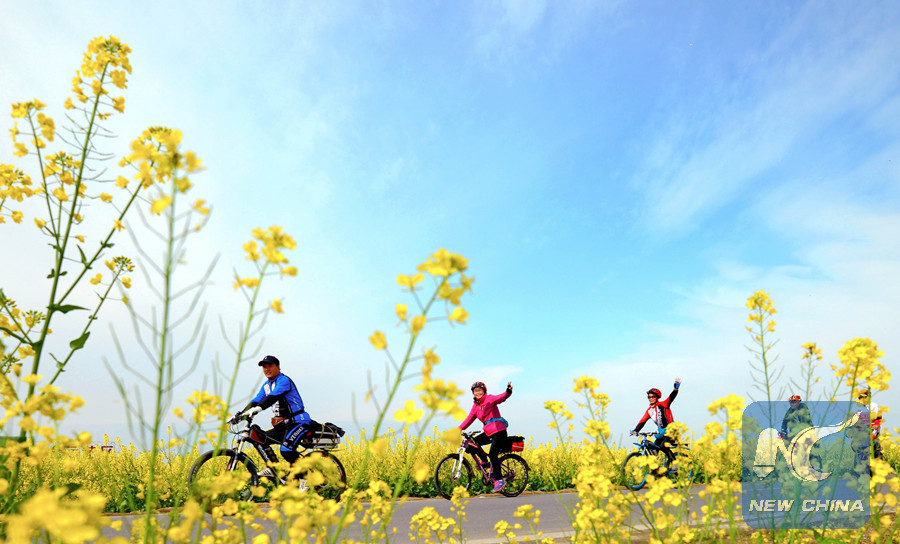
Visitors ride bicycles along the field of flowers in Ranyi Township of Chengdu, southwest China's Sichuan Province, March 11, 2018. Rural tourism has been stressed as a crucial part of China's strategies of rural vitalization. (Xinhua/Jiang Hongjing)

CHICAGO, March 12 (Xinhua) -- China is winning its war on pollution after four years of struggle, a U.S. study said on Monday.

Concentrations of fine particulates in Chinese cities have decreased by an average rate of 32 percent since 2014, according to a research done by professors at the University of Chicago.

Data from nearly 250 Chinese official monitor agencies was analyzed with positive findings.

"The data is in-China is winning its war against pollution," said Michael Greenstone who conducted the analysis and works as director of the Energy Policy Institute at the University of Chicago (EPIC).

Workers clean the surface of the Qiandaohu Lake in Chun'an County of east China's Zhejiang Province Aug. 16, 2017. The lake, a famous scenic spot, is under stricter protection now as the local government issued a zero emission policy according to which garbage disposal, residents' waste water and vehicle emission are under tighter control. (Xinhua/Xu Yu)

New data released by Chinese government in March showed that the number of "severely polluted" days in Beijing dropped to 23 in 2017, compared with 58 in 2013.

Across the country, the average density of PM 2.5 in 338 cities was 43 micrograms per cubic meter, falling 6.5 percent year on year.

The eight-page report suggested that Chinese people would enjoy significant improvement of their health conditions, or life span extended by months or years.

"In the 204 prefectures for which we have data, which cover nearly 70 percent of the total population, residents can expect to live on average 2.4 year longer relative to 2013 if the recent reductions in pollution are sustained," said the report.

While praising China's "significant gains in achieving its air quality goals," the report expected more longer-term plans and market approaches like taxes and cap-and-trade markets.
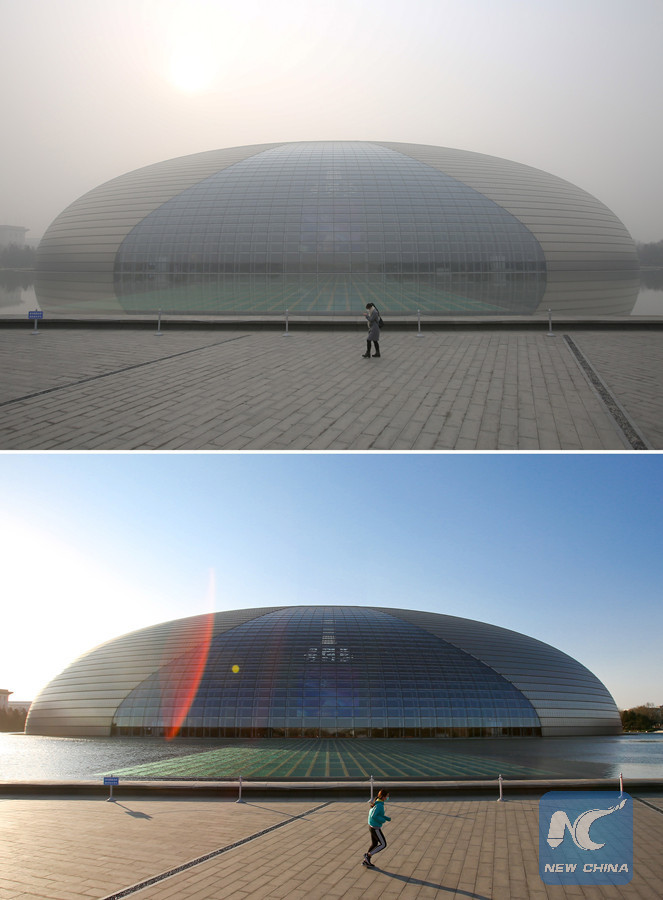
The combo photo taken on Dec. 21 (up) and Dec. 22, 2016 (down) shows the National Center for the Performing Arts in Beijing, capital of China. Beijing lifted a red alert for air pollution on Wednesday night as cold air dispersed the smog that affected the city for days. (Xinhua/Zhang Cheng)

Based on action plans made by Chinese governments at all levels, the war on pollution was fought as plants reduced emissions, fossil-fuel based power generation converted to renewable energy, cities restricted cars on roads and the planting of additional greenery.

China also reduced its iron- and steel-making capacity, shut down coal mines as well since the State Council launched a national air pollution control campaign in 2013.

China is working on a new three-year plan to continue controlling air pollution, while a goal was set for cities at the prefecture level and above to experience about 292 clear air days each year by 2020.

Back to Top Close
Xinhuanet

China's war on pollution winning: report

Source: Xinhua 2018-03-13 17:08:22

Visitors ride bicycles along the field of flowers in Ranyi Township of Chengdu, southwest China's Sichuan Province, March 11, 2018. Rural tourism has been stressed as a crucial part of China's strategies of rural vitalization. (Xinhua/Jiang Hongjing)

CHICAGO, March 12 (Xinhua) -- China is winning its war on pollution after four years of struggle, a U.S. study said on Monday.

Concentrations of fine particulates in Chinese cities have decreased by an average rate of 32 percent since 2014, according to a research done by professors at the University of Chicago.

Data from nearly 250 Chinese official monitor agencies was analyzed with positive findings.

"The data is in-China is winning its war against pollution," said Michael Greenstone who conducted the analysis and works as director of the Energy Policy Institute at the University of Chicago (EPIC).

Workers clean the surface of the Qiandaohu Lake in Chun'an County of east China's Zhejiang Province Aug. 16, 2017. The lake, a famous scenic spot, is under stricter protection now as the local government issued a zero emission policy according to which garbage disposal, residents' waste water and vehicle emission are under tighter control. (Xinhua/Xu Yu)

New data released by Chinese government in March showed that the number of "severely polluted" days in Beijing dropped to 23 in 2017, compared with 58 in 2013.

Across the country, the average density of PM 2.5 in 338 cities was 43 micrograms per cubic meter, falling 6.5 percent year on year.

The eight-page report suggested that Chinese people would enjoy significant improvement of their health conditions, or life span extended by months or years.

"In the 204 prefectures for which we have data, which cover nearly 70 percent of the total population, residents can expect to live on average 2.4 year longer relative to 2013 if the recent reductions in pollution are sustained," said the report.

While praising China's "significant gains in achieving its air quality goals," the report expected more longer-term plans and market approaches like taxes and cap-and-trade markets.

The combo photo taken on Dec. 21 (up) and Dec. 22, 2016 (down) shows the National Center for the Performing Arts in Beijing, capital of China. Beijing lifted a red alert for air pollution on Wednesday night as cold air dispersed the smog that affected the city for days. (Xinhua/Zhang Cheng)

Based on action plans made by Chinese governments at all levels, the war on pollution was fought as plants reduced emissions, fossil-fuel based power generation converted to renewable energy, cities restricted cars on roads and the planting of additional greenery.

China also reduced its iron- and steel-making capacity, shut down coal mines as well since the State Council launched a national air pollution control campaign in 2013.

China is working on a new three-year plan to continue controlling air pollution, while a goal was set for cities at the prefecture level and above to experience about 292 clear air days each year by 2020.

010020070750000000000000011103261370363981